
"I get that you want an AI tool, but is it secure?"
When proposing an internal AI tool, the IT manager is caught between the team's enthusiasm and leadership's concerns. "It looks useful" is not enough to get approval. You need a business case that preemptively addresses every question leadership will ask.
This article walks through seven checklist items for getting an internal AI tool approved, along with strategies for overcoming the most common objections.
What you will learn
- Seven checklist items every AI tool business case needs
- Specific questions to verify for each item
- Common reasons for rejection and how to counter them
- Example answers using Monoshiri AI
Check 1: Security
This is the number-one concern for leadership. Confirm and document the following four points.
Where is the data stored?
For cloud services, the data storage region matters. If data is stored overseas, cross-border data transfer issues come into play.
Is data encrypted in transit and at rest?
TLS (transit encryption) and AES-256 (at-rest encryption) are baseline requirements. Also check how encryption keys are managed -- by the vendor or by the customer.
Is tenant isolation enforced?
For multi-tenant SaaS, verify the level of logical or physical separation between your data and other customers' data.
Is data used to train the AI?
With generative AI services, whether input data is used for model training is a major concern. Confirm that the vendor explicitly states data is not used for training.
Monoshiri AI: All data is stored in the AWS Tokyo region. Communications are encrypted with TLS; stored data with AES-256. Database and vector indexes are isolated per tenant. Uploaded data is never used for AI model training. See the security page for details.
Check 2: Cost
A business case needs more than "X dollars per month." Present the total annual cost.
Pricing considerations:
- Whether there is an upfront fee
- Per-user pricing vs. flat rate
- If usage-based billing applies, whether there is a cap
- Annual contract discounts
Annual cost projection example
Including a comparison of current operational costs (converted to labor hours) versus post-deployment costs adds persuasive power. For example: "Our team spends 20 hours per month on internal inquiries. At average labor cost, that is $36,000/year. A $100/month tool saves roughly $34,800 annually."
Monoshiri AI: No upfront fees. Flat-rate plans with no per-user charges. See the pricing page for details.
Check 3: Deployment effort
"It will take six months to deploy" kills momentum. Demonstrating speed of deployment matters.
Items to verify:
- Time required for initial setup
- IT team effort (environment setup, account configuration, integrations)
- Training effort for end users
- Ongoing maintenance and operational overhead
Monoshiri AI: After creating an account, simply upload documents to start. No specialized IT knowledge required -- no server setup or API integration needed. Designed so a single admin can manage it.
Check 4: Legal compliance
If internal documents containing personal information are involved, legal compliance verification is mandatory.
Items to verify:
- Compliance with personal data protection laws (handling of personal data, third-party disclosure)
- Confidentiality clauses in the service agreement
- Data deletion policy (retention period after cancellation, guarantee of complete deletion)
- Scope of data handling defined in the terms of service
For AI services in particular, whether input data constitutes "third-party disclosure" is a key point also addressed in data protection authority FAQs.
Monoshiri AI: The terms of service clearly define the scope of data handling. Uploaded data is never used for AI training. Data deletion policy after cancellation is specified. See the terms of service for details.
Check 5: Availability
If a tool will be used daily, you need to plan for "what happens when it goes down."
Items to verify:
- SLA (service uptime guarantee) availability and level
- Data backup practices (frequency, retention period)
- Incident notification and response procedures
- Historical incident record and recovery track record
Monoshiri AI: Runs on the AWS Tokyo region. The database uses Aurora MySQL with automatic backups. A Multi-AZ architecture eliminates single points of failure for high availability.
Check 6: Integration
Whether the tool fits into existing workflows directly affects adoption.
Items to verify:
- Integration with existing chat tools (Slack, Teams, etc.)
- Website embedding (chat widget)
- LINE integration (for external inquiry handling)
- SSO (single sign-on) support
Monoshiri AI: Supports website chat widget embedding and LINE official account integration. Useful not only for internal use but also for customer-facing FAQ support.
Check 7: Exit strategy
An often-overlooked aspect of the approval process is "what it costs to leave." Leadership cares about what happens if the tool does not work out.
Items to verify:
- Minimum contract period
- Ease of cancellation
- Data export capability (format, scope)
- Vendor lock-in risk
Monoshiri AI: No minimum contract period. Cancel on a monthly basis. Uploaded documents can be downloaded at any time, making migration to another service straightforward.
Common rejection reasons and how to counter them
Rejections follow predictable patterns. Prepare your responses in advance.
"I'm worried about security"
Counter: Attach comprehensive answers covering all items in Check 1. Emphasize that "data is not used for AI training." A pre-consultation with the information security team also helps.
"The ROI isn't clear"
Counter: Calculate current operational costs (inquiry handling hours x hourly rate) and project the savings from deployment. Proposing a trial in a single department with a defined evaluation period is also effective.
"Can't we just use existing tools?"
Counter: Clearly articulate the difference from existing file servers and FAQ pages. Explain the unique value of AI: "You can ask questions in natural language instead of keyword searches" and "It searches across document content and generates answers."
"Nobody will use it even if we deploy it"
Counter: Highlight integration features (LINE, web chat) that embed naturally into existing workflows. Proposing a phased rollout -- starting with one department and expanding based on results -- tends to gain easier buy-in.
Summary: the complete checklist
Here are all seven items at a glance. Use this as a checklist when preparing your business case.
| # | Check Item | Key Considerations |
|---|---|---|
| 1 | Security | Data location, encryption, tenant isolation, AI training usage |
| 2 | Cost | Upfront fees, monthly cost, pricing model, annual projection |
| 3 | Deployment effort | Setup time, IT team effort, operational overhead |
| 4 | Legal compliance | Data protection law, confidentiality, data deletion policy |
| 5 | Availability | SLA, backups, incident response |
| 6 | Integration | Existing tool integration, LINE, website embedding |
| 7 | Exit strategy | Cancellation terms, data export, lock-in avoidance |
Instead of a vague "It seems good," build a business case that answers each of leadership's concerns one by one. That is the first step toward getting an internal AI tool approved. Use the checklist above to prepare a compelling case.
Share this article
Related Articles
![How to Connect Claude, Gemini & Codex via MCP [2026 Edition]](/blog/mcp-connection-guide/header.jpg)
How to Connect Claude, Gemini & Codex via MCP [2026 Edition]
Learn how to connect Claude Desktop, Claude.ai, Gemini CLI, Codex, Dify, and Cursor to your company's knowledge base using Monoshiri AI's MCP (Model Context Protocol) support.

5 Things to Do in the First 30 Days After Adopting an AI Knowledge Base
A week-by-week action plan for the first 30 days after deploying an AI knowledge base. Prevent the 'we bought it but nobody uses it' trap and build a knowledge base that grows with your team.
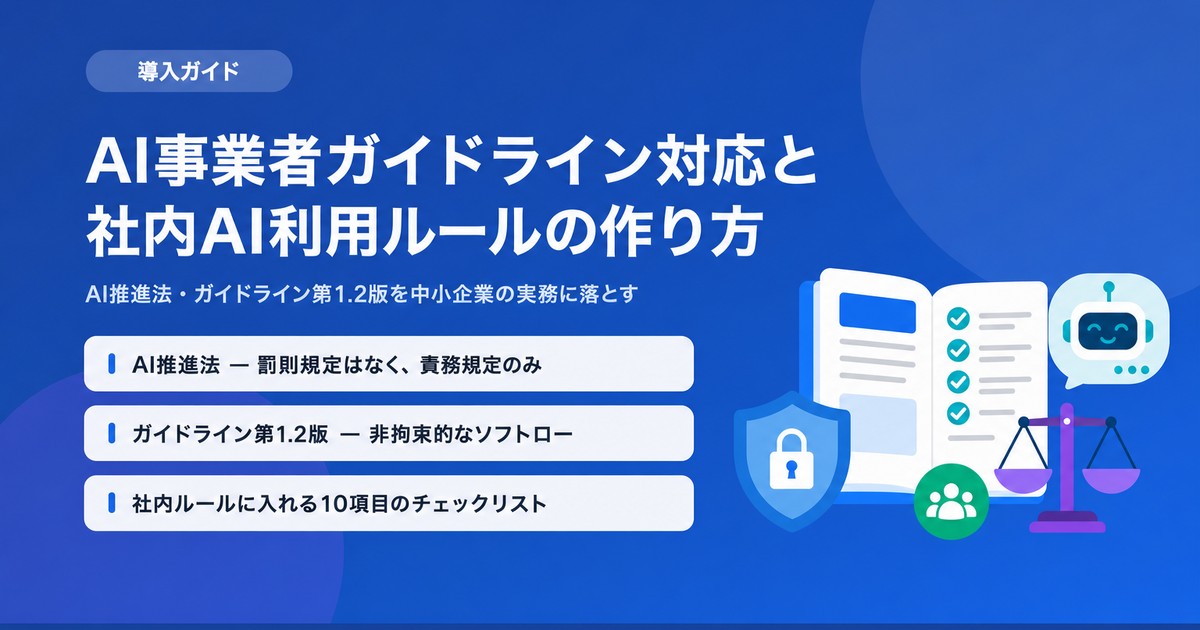
Japan's AI Guidelines: Writing an Internal AI Usage Policy (2026)
Japan's AI Promotion Act and the AI Guidelines for Business v1.2: what they actually ask of a small or mid-sized company, and 10 items for your internal AI policy.