ものしりAI
GLOSSARY

AI Glossary

We explain AI-related technical terms involved in putting internal knowledge to use, from the fundamentals to implementation terms for engineers, covering AI, generative AI, RAG, LLMs, MCP, and more. Start with whichever term you are curious about.

Fundamentals of AI and Generative AI

AI (Artificial Intelligence)

AI (Artificial Intelligence) is a broad term for technology that enables computers to perform intellectual tasks once handled by people, such as understanding language, making judgments, and predicting outcomes. It does not refer to a single technique; it spans everything from classic rule-based methods to today's generative AI. In recent years, machine learning, which learns from large volumes of data, has become the mainstream approach and has dramatically improved performance. In day-to-day operations, AI is increasingly used to assist with work that used to rely on people, such as searching documents, handling inquiries, and summarizing content.

Generative AI

Generative AI refers to AI that creates new text, images, audio, and more. Chat-style services that answer your questions in natural sentences are one kind of generative AI, assembling fluent text in line with the instructions they are given. Whereas earlier AI focused mainly on classification and prediction, generative AI is distinctive in that it produces content from scratch. When it comes to putting internal knowledge to use, it shines in situations such as reading documents to organize the key points, or answering employees' questions in clear, easy-to-understand language.

Machine Learning

Machine learning is an approach in which a system automatically learns patterns from large amounts of data, so it can predict and classify without a person writing out every rule by hand. For example, by training it on a history of past inquiries, it can learn to infer the intent behind new questions. This differs in mindset from traditional programming, where humans spell out in detail what to do in each case. Modern generative AI and AI-powered search are also built on machine learning, making it a foundational technology that supports the use of internal data.

Deep Learning

Deep learning is a type of machine learning that learns using multilayered networks modeled on the neural circuits of the human brain. By stacking many layers, it became able to capture features even from complex data such as images and text. The process of converting the meaning of text into numbers, as well as the language models at the heart of generative AI, are also built on this technology. Mechanisms that search internal documents by meaning or generate natural-sounding answers ultimately trace back to the achievements of deep learning.

Natural Language Processing (NLP)

Natural Language Processing (NLP) is the field of technology that lets computers understand and generate the language people use in everyday life. It covers tasks such as reading the meaning of text, summarizing, translating, and answering questions. Human language is full of inconsistent wording and paraphrasing, which makes it hard to handle, and it has been a research challenge for many years. Accuracy has improved greatly with the recent arrival of large language models. Mechanisms that let you ask AI questions about internal documents are an application of natural language processing.

ChatGPT

ChatGPT is a conversational generative AI service provided by OpenAI. Because you simply enter questions or instructions in natural language and receive answers in text, it has become many people's first encounter with AI. It is used for a wide range of purposes, including writing, summarizing, and brainstorming. On the other hand, ordinary ChatGPT does not know your company's internal documents, so it cannot answer questions specific to your organization. To get answers grounded in internal information, you need a separate mechanism that lets it reference your own documents.

Prompt

A prompt is the instruction or question you give to an AI. Even when asking about the same thing, spelling out the assumptions and the desired output format can dramatically change the quality of the answer. For example, "summarize this in three bullet points" yields a result closer to your intent than simply "summarize this." The craft of designing high-quality prompts is also called prompt engineering. When using AI internally, it helps to remember that a small adjustment in how you ask can meaningfully improve how useful the results are.

Hallucination

A hallucination is when an AI answers with content that is not factual, presented in plausible-sounding language. Because AI assembles natural text probabilistically, it can confidently make things up even about topics it does not actually know. In internal use, being given an incorrect policy or procedure can disrupt work, so this calls for special caution. As a countermeasure, it is effective to tie the AI's answers to actual internal documents and have it respond while citing its basis. Whether a tool lets you verify the source is an important factor when deciding to adopt it internally.

Multimodal

Multimodal refers to an AI's ability to handle multiple types of information at once, not just text but also images, audio, and documents. For example, it can read a PDF or photo containing diagrams and tables and answer questions about its contents. Compared with text-only AI, it can work with a wider range of information, closer to the realities of the field. Because internal knowledge often includes not only text but also diagrams and screenshots, multimodal support directly translates into practical convenience in real-world work.

AI Agent

An AI agent is an AI that, given an instruction, works out the steps on its own and carries out a series of tasks while using the tools it needs. Rather than simply answering a question, it autonomously chains together multiple stages such as researching, comparing, and summarizing. For instance, it can search internal documents, gather related information, and produce a summary all in one flow. It is drawing attention as a way to advance work automation a step further, but managing permissions and setting rules to prevent malfunctions are also important.

LLMs and Models

LLM (Large Language Model)

An LLM (Large Language Model) is a massive AI model that has learned from enormous volumes of text and has become able to handle language much like a human. A single model can perform a wide range of language-related tasks, including generating, summarizing, translating, and answering questions. It is the core of generative AI, and many services, starting with ChatGPT, are built on LLMs. In a mechanism that lets you ask AI about internal documents, it is ultimately this LLM that assembles the final answer. A model's performance and characteristics have a major impact on answer quality.

GPT Family (OpenAI)

The GPT family is the line of large language models developed by OpenAI, and it is also the foundation that powers ChatGPT. It is highly versatile, performing in a well-balanced way across a wide range of uses from writing and summarizing to coding. Many enterprise AI services adopt it as an option, and its rich ecosystem is another strength. Multiple models are offered for different purposes, so you choose based on the accuracy and cost you need. How to use the various model families is explained in detail in our comparison of AI models for internal use.

Claude Family (Anthropic)

The Claude family is the line of large language models developed by Anthropic. It is said to excel at handling long passages of text as a whole, at safety considerations, and at coding performance, making it a good fit for working with lengthy internal documents. Its tendency to follow instructions faithfully and to produce polished, readable text is also well regarded. In putting internal knowledge to use, it shines when answering based on long materials such as policy manuals and handbooks. The characteristics of each model family and how to choose are organized in our comparison of AI models for internal use.

Gemini Family (Google)

The Gemini family is the line of large language models developed by Google. It is said to be strong at handling extremely long context all at once, and at multimodal performance that understands text and images together. Easy integration with Google's various services is another of its features. For internal knowledge, it is well suited when you want to reference materials with diagrams and tables, or large volumes of documents, all at once. Since there is no one-size-fits-all answer for which model family suits your use case, please refer to our comparison of AI models for internal use as a guide.

Open Models (Llama / DeepSeek / Mistral / Qwen, etc.)

Open models are a general term for large language models whose architecture and weights are published, so you can run them in your own environment. Llama, DeepSeek, Mistral, and Qwen are representative examples. Because you can operate them yourself without relying on an external service, they are chosen when you do not want highly confidential data to leave the company, or when you want to keep usage costs down. On the other hand, operating them requires a fair amount of infrastructure and expertise. Whether a commercial model or an open model is the better fit is best judged in light of your confidentiality requirements, cost, and operational capacity.

SLM (Small Language Model)

An SLM (Small Language Model) is a lightweight language model with a reduced number of parameters. Compared with large models, its performance ceiling tends to be lower, but it runs quickly and can be operated at low cost. It is well suited to running on a smartphone or local device, or to a narrow set of specific tasks. The largest possible model is not necessarily required for every job, and choosing the scale to match the use case lets you balance cost and speed. Even in internal use, a small model is often enough for lightweight inquiries.

Reasoning Models

Reasoning models are models that have become stronger at complex problems by going through a step-by-step process of "thinking" before producing an answer. Accuracy improves on tasks that require calculation or logical procedures, and on questions that combine multiple conditions. In return, they tend to take more time and cost to reach an answer, so it is effective to use them for selected purposes. In internal use, one approach is to use an ordinary model for simple fact-checking and a reasoning model for consultations that require intricate judgment.

Number of Parameters

The number of parameters is the quantity of adjustable values a model holds internally, and it is a representative indicator of a model's scale. In general, more parameters tend to mean higher performance, but they also increase computational cost and response time accordingly. That said, a larger number is not always better; the quality of the training data and design also affects performance. When choosing a model internally, it is important not to fixate on parameter count alone, but to decide based on the balance of the accuracy, speed, and cost you require.

Context Window

The context window refers to the upper limit on the length of text a model can read in at one time. The longer it is, the more materials and the longer a conversation history you can hand over for an answer at once. When working with internal documents, there is often a need to reference long manuals or multiple policies together, so a wide context window affects practicality. At the same time, more is not always better; feeding in large amounts of low-relevance information can be disadvantageous in terms of accuracy and cost.

Token

A token is the smallest unit by which an AI processes text. Text is split into chunks of words or characters, and pricing and the upper limit on input length are counted in these tokens. In English, roughly one word corresponds to one token or so. The cost of using an AI service is often determined by token count, so the longer the documents you handle, the higher the cost. When using AI internally, understanding the unit of tokens helps in estimating the volume of documents you will handle and the associated cost.

Benchmarks (MMLU, etc.)

A benchmark is an indicator that measures a model's performance on a shared set of problems to serve as a yardstick for comparison. There are many kinds for different purposes, such as MMLU, which tests broad knowledge, as well as ones that measure coding ability or reasoning. A model with a higher score is generally considered superior, but the abilities required by test problems do not always match those needed in actual work. When choosing a model internally, the surest approach is to use benchmarks as a reference while also trying it out on your own real data.

Fine-tuning

Fine-tuning is a method of training an existing model on additional data to optimize it for a specific use or writing style. It is used when you want to create responses tailored to specialized field expressions or to your company's particular operations. However, preparing the training data and retraining are costly, and updating the content is also laborious. If your goal is to make use of internal documents, then in many cases referencing documents at answer time is easier and keeps information more up to date than retraining the model itself.

temperature / top-p

temperature and top-p are parameters that adjust the variability of an AI's answers, in other words the balance between creativity and stability. Raising the values makes expression more varied and creative, while lowering them produces more consistent, dependable answers. A higher setting suits situations where you want to diverge, such as brainstorming, while a lower setting suits situations that demand accuracy, such as checking internal policies. For internal knowledge inquiries, where a consistent answer every time is desirable, settings that suppress variability tend to be preferred.

System Prompt

A system prompt is a setup instruction that tells the AI its role and the rules it must follow in advance. Separate from the questions a user types in each time, it takes effect as the premise for the entire conversation. For example, you can set policies such as "answer based on internal policies, citing your basis" or "if you do not know, say so rather than guessing." In internal use, it plays an important role in suppressing hallucinations and unifying the tone and scope of answers. It is the foundational setting for safe, consistent operation.

How Search, RAG, and Answer Generation Work

RAG (Retrieval-Augmented Generation)

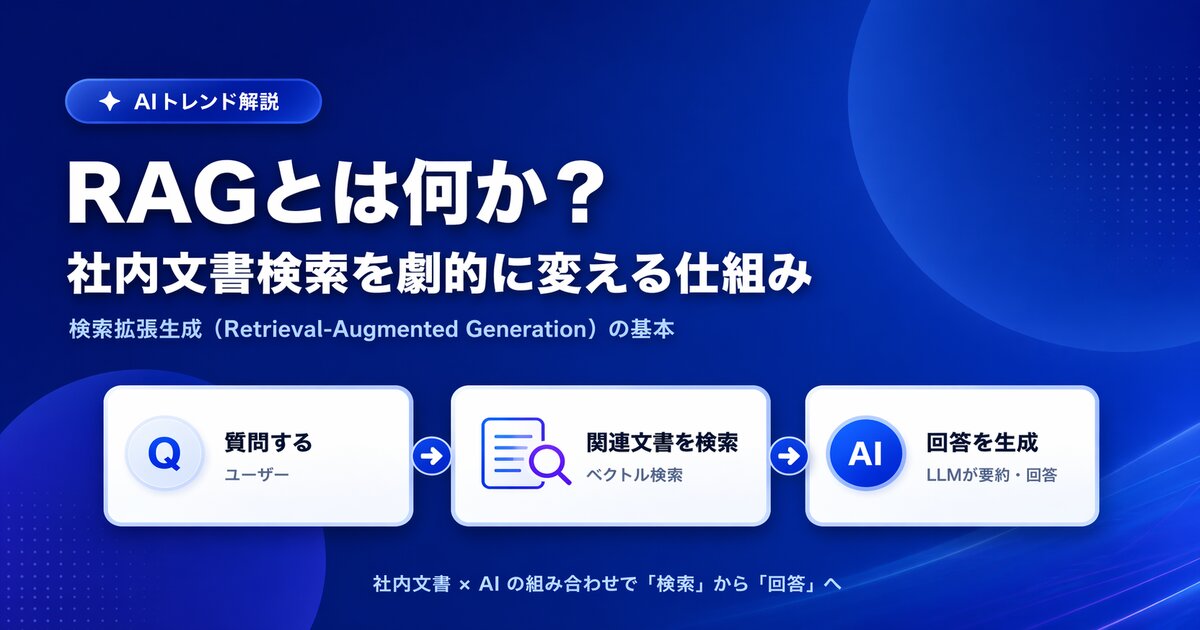
RAG (Retrieval-Augmented Generation) is a mechanism in which relevant documents are first searched in response to a question, and the AI then generates an answer based on their contents. Rather than answering from its own memory alone, the AI references internal documents as its "basis" before responding, so it can answer accurately even on company-specific information and is less likely to give answers that differ from the facts. It is widely used as a basic mechanism for putting internal documents to work. For the big picture of RAG and why it suits internal document use, see our article explaining what RAG is.

Vector Search

Vector search is a search method that converts text into a sequence of numbers (a vector) and finds documents based on their "closeness in meaning." Unlike traditional search that looks for matching character strings, it can find things even when there is paraphrasing or inconsistent wording, as long as the meaning is close. For example, it can treat "paid leave" and "annual leave" as the same content even though the wording differs. It is one of the foundational technologies for using internal documents with AI. The mechanism and the steps to adopt it are explained concretely in our article on how to search internal documents with AI.

Vector DB / Vector Index

A vector DB / vector index is a database and index structure for storing vectorized documents and rapidly finding documents with similar meaning. By using an indexing algorithm such as HNSW, it can locate close matches instantly even from a large volume of documents. The reason search does not slow down as internal documents grow is that this kind of mechanism supports it. Users do not need to be aware of this internal structure, but understanding it as an element that quietly underpins the speed and accuracy of AI search is useful.

Embedding

An embedding is the process of converting text into a numeric vector while preserving its meaning. Passages that are close in meaning are placed at nearby positions in the converted numeric space. It is precisely because of this conversion that you can search for documents by meaning even when the character strings do not match. It is the prerequisite, so to speak the prep work, behind vector search and semantic search. When internal documents are ingested, each document goes through this embedding process and is prepared into a form that can be searched by meaning.

Semantic Search

Semantic search is a search method that finds documents based on "closeness in meaning" rather than word matching. It is strong against paraphrasing and inconsistent wording, finding "expense reimbursement" and "reimbursement of advance payments" as the same content even when the wording differs. The advantage is that you can reach the information you want by asking in natural language, even without coming up with the exact keyword. It is a search method that pairs well with using internal documents. Its mechanism and differences are explained in detail in our article on how to search internal documents with AI.

Keyword Search / Full-Text Search

Keyword search / full-text search is the traditional kind of search that finds documents whose character strings match the words you enter. While the mechanism is easy to understand, it is weak against inconsistent wording and paraphrasing, so with internal documents you tend to hit the limit of "it should be there, but I can't find it." Known issues include the contents of scanned PDFs not being searchable, and being unable to combine an answer that spans multiple documents. The specific symptoms of this limit and how to diagnose them are organized in our article explaining the limits of keyword search.

Hybrid Search

Hybrid search is a method that combines keyword search, which looks at character-string matches, with vector search, which finds by closeness in meaning, raising accuracy with the strengths of both. Keyword search is good at searches where an exact character string such as a proper noun or model number matters, while vector search is good at natural sentences with lots of paraphrasing, so using them together reduces what slips through. Because internal documents mix strict terms such as product codes with colloquial phrasing, there are many situations where hybrid search works effectively.

BM25

BM25 is a scoring method long used in full-text search that takes the importance of words into account. It ranks the relevance of search results by factoring in how often a word appears in a document and how rare that word is. Simple yet practical, it is still widely used today as the standard foundation for keyword search. In hybrid search, which combines it with vector search, BM25 often handles the score on the character-string-matching side. It demonstrates steady strength in situations where you are searching for proper nouns or exact phrases.

Chunking

Chunking is the process of dividing a document into appropriately sized units that are easy to search. Handling a long document as is reduces search accuracy, so it is split at meaningful boundaries such as headings and paragraphs. How it is split greatly affects answer accuracy: chunks that are too fine lose context, while chunks that are too large mix in unrelated information. The more structured a document is, such as an internal manual, the more effective appropriate splitting becomes. As a behind-the-scenes process that supports search accuracy, our article on how to search internal documents with AI is also a helpful reference.

Reranking

Reranking is the process of reordering the candidate documents gathered by search, from most to least relevant to the question, to raise accuracy. Because the initial search prioritizes speed and gathers candidates broadly, the order is not necessarily optimal. By reassessing relevance one notch more finely, it pushes the information you truly need to the top. It is effective for choosing the right basis when, as with internal documents, there are multiple pieces of similar content. It can be called the finishing step that lifts answer quality up a level.

Top-k

Top-k is the setting that indicates how many of the top candidates found by search are passed to the AI as its basis. Raising the value of k lets it reference more documents, but low-relevance information can get mixed in and lower accuracy, or increase cost. Conversely, too small a value risks dropping information needed for the answer. In internal document search, tuning to an appropriate number based on the nature of the question balances accuracy and efficiency. It is an unglamorous but accuracy-relevant tuning knob.

Cosine Similarity

Cosine similarity is a representative measure that gauges closeness by how similarly two vectors are oriented. In vector search, the question and a document are each converted into vectors, and a document with higher cosine similarity is judged to be "closer in meaning." Because the value expresses the degree of directional agreement, it is relatively unaffected by the length of the text. Users never touch it directly, but it is the foundational calculation that supports the accuracy of semantic search, which finds documents by meaning, from the numerical side.

Grounding (Source Attribution)

Grounding (source attribution) means tying the AI's answers to actual documents and showing which materials served as the basis. When you can verify not just the answer but also its source, users can confirm the correctness of the content themselves and use it for work with confidence. An answer of unknown origin, however plausible, is hard to take at face value. In internal use, this directly affects the reliability of conveying policies and procedures without error, so whether a tool answers while showing its basis is an important criterion in choosing a tool.

Long Context

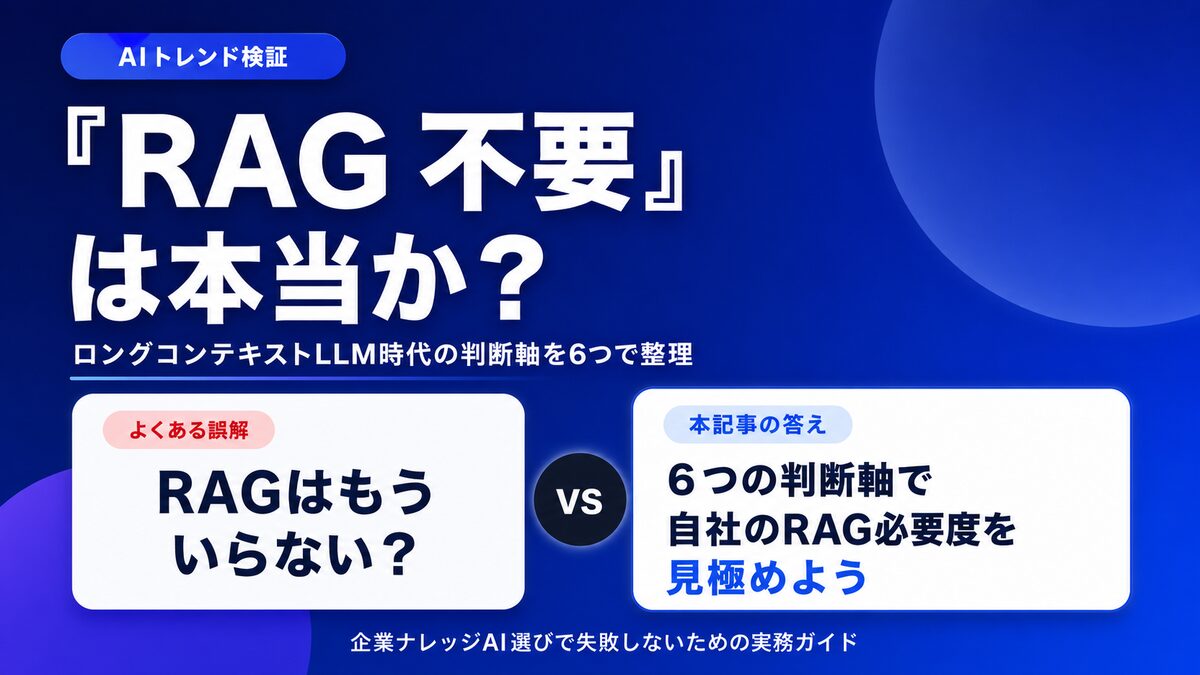
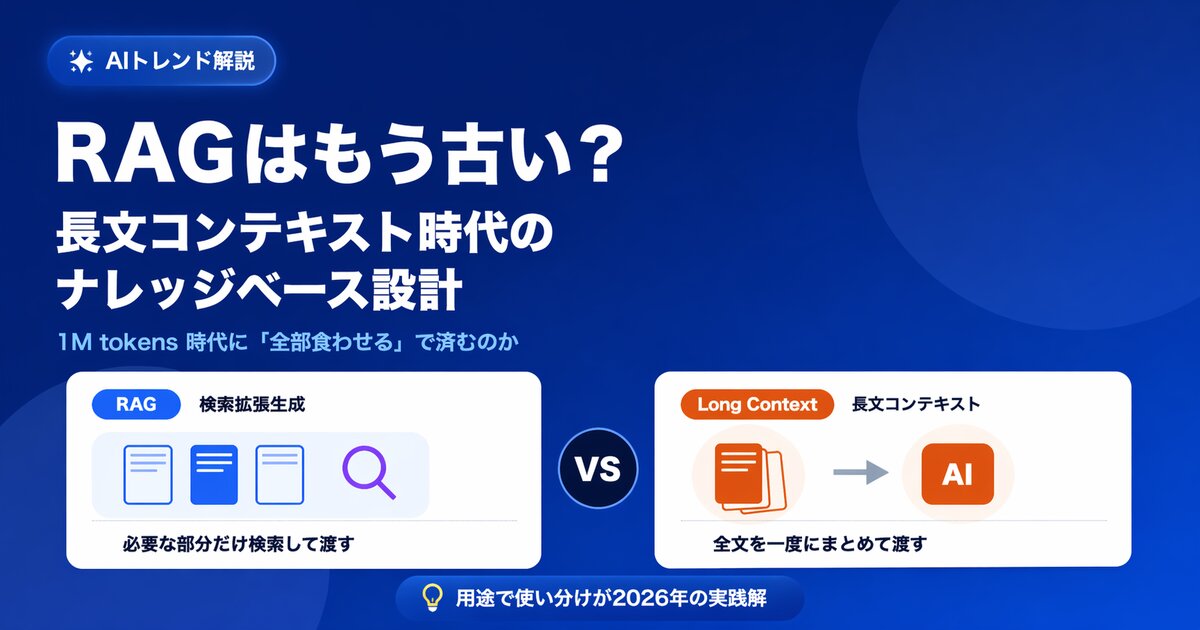
Long context refers to a model's ability to handle very long text all at once. Since you can hand over a long manual or multiple materials as is and have it answer, the number of convenient situations has increased. Against the backdrop of this improving ability, a debate has even emerged over whether "RAG, which searches and hands over documents, might be unnecessary." In reality, though, suitability is divided by cost, the freshness of information, and the volume of documents handled. How to use the two appropriately is organized in detail in our article comparing RAG and long context.

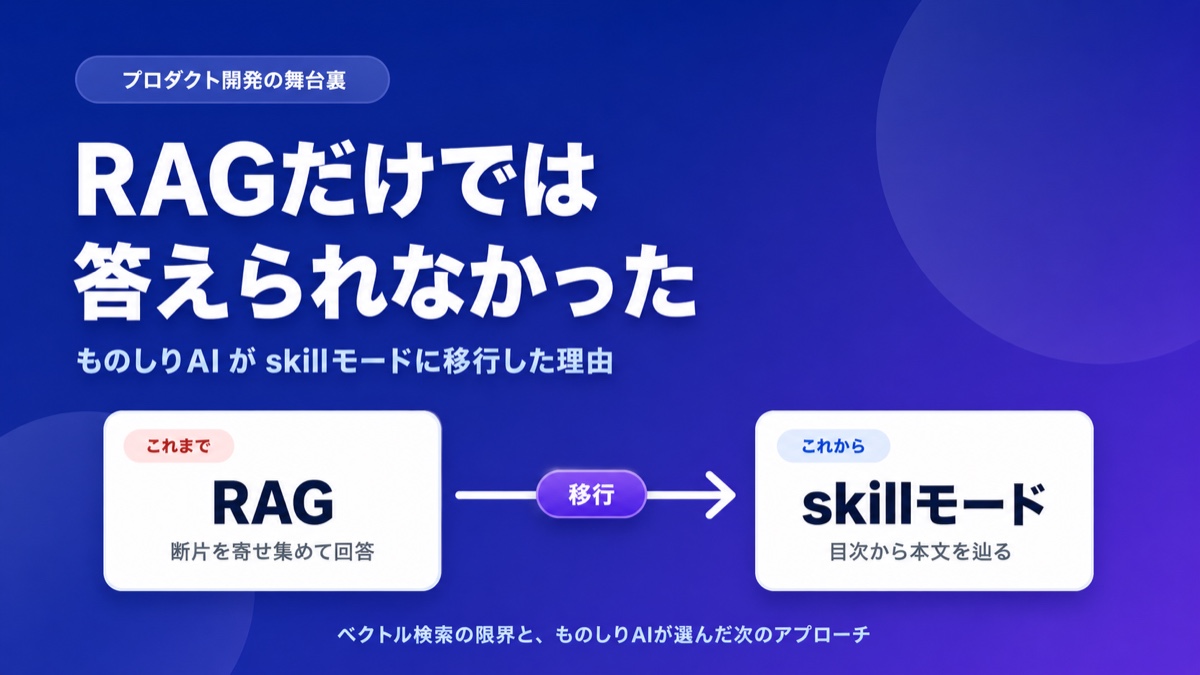
Corpus2Skill

Corpus2Skill is an approach that converts a body of documents (a corpus) into "skills" the AI can use, and it is drawing attention as a complement to, or substitute for, RAG. By organizing and structuring the contents of documents in advance, there is potential to draw out internal knowledge more accurately and at lower cost, without relying on a search every time. It is a relatively new idea, and its differences from RAG and where it fits are points of discussion. How Monoshiri AI arrived at this idea after real-world validation of RAG is introduced in detail in our article on why we moved away from RAG.

The "RAG Is Unnecessary" Argument

The "RAG is unnecessary" argument is the claim that as models gain longer context, RAG, which searches and hands over documents, will no longer be needed. It is true that situations where you can handle long text as is have increased, but in reality suitability is divided by conditions such as document volume, cost, and the freshness of information, so you cannot say one is universally superior. For internal document use, the realistic approach is to understand the characteristics of both and use them appropriately. The examination of this point is explored in depth in our article addressing the "RAG is unnecessary" argument.

Integration, Protocols, and Tool Execution

MCP (Model Context Protocol)

MCP (Model Context Protocol) is a mechanism for connecting AI clients to external data and tools in a standardized way. By going through this common standard, you can connect to internal documents in the same way from various AIs such as Claude, Gemini, and Codex. The advantage is reducing the effort of building a separate integration for each tool. It is useful when you want to reference internal knowledge directly from the AI client you usually use. The concrete steps for connecting are explained in our MCP connection guide article and on the MCP integration landing page.

Function Calling / Tool Use

Function Calling / Tool Use is a mechanism by which an LLM calls external tools or APIs to carry out actual processing such as searching or operations. Beyond simply answering in text, the AI becomes able to take actions such as "search internal documents" or "retrieve data." This lets the AI handle the latest information outside its own knowledge, as well as real-time operations. In putting internal knowledge to use, it is the foundational mechanism that supports the flow in which the AI invokes a document search as needed and gathers its basis before answering.

API Integration

API integration is a connection method for exchanging data between external services, program to program. By going through a defined gateway called an API, systems can hand information back and forth automatically without human intervention. For example, you can integrate with an internal chat tool or groupware so that people can ask the AI questions from a screen they are already used to. Because you can incorporate AI while making use of existing business systems, it is an important mechanism when thinking about ease of tool adoption and operational automation.

Chat Widget

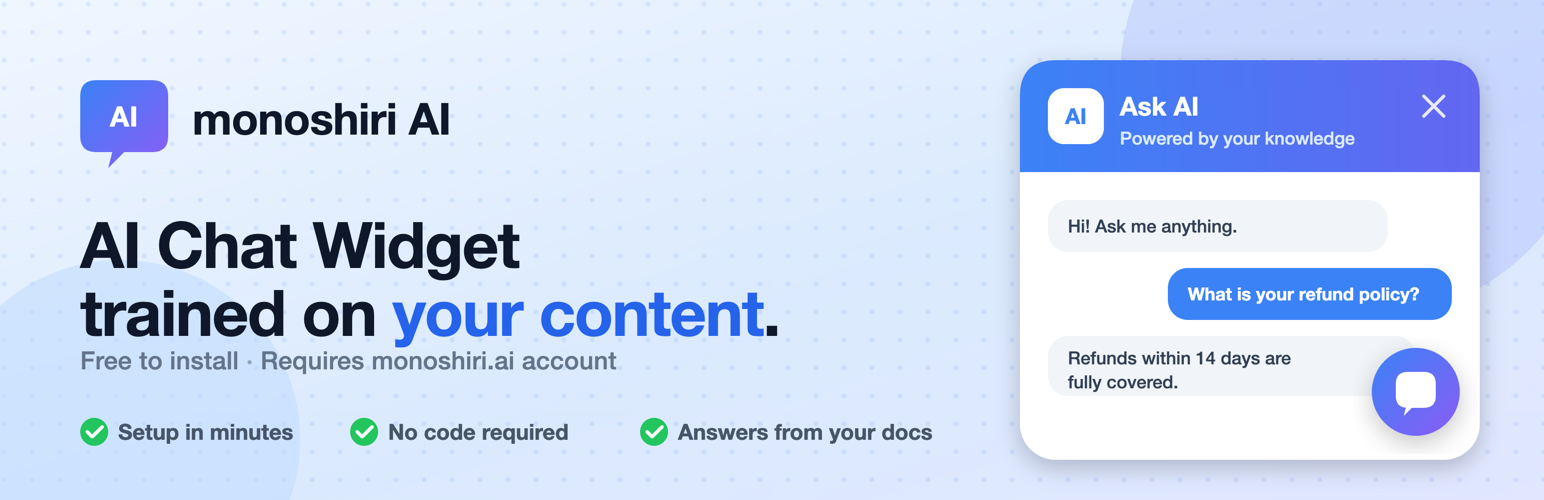
A chat widget is a small chat window placed on a website. When a visitor enters a question, the AI answers automatically based on internal documents and FAQs. It reduces the burden of handling inquiries while giving visitors answers on the spot, around the clock. It can be used for both internal and external audiences, and people use it more casually than a dedicated inquiry form. How to install it and how to roll it out are introduced in detail in our article on adopting a chat widget and on the chatbot landing page.

Scenario-Based Chatbot

A scenario-based chatbot is a bot that responds along predetermined branches and choices. It guides users with prompts like "please select the applicable item," leading them to prepared answers. While it can reliably answer anticipated questions, it cannot handle questions that fall outside the branches, and creating and maintaining the scenarios takes effort. By contrast, the "ask the AI" approach, which references internal documents directly to answer open-ended questions, requires no upfront scenario design. The two can be used appropriately depending on the use case.

ReAct / Chain of Thought (CoT)

ReAct and Chain of Thought (CoT) are methods that refine the process by which an AI arrives at an answer. Chain of Thought, rather than producing a conclusion outright, shows the line of reasoning step by step, raising the accuracy rate on complex problems. ReAct is the idea of reaching an answer by alternating that reasoning with actions that use tools. With these, the AI becomes able to handle intricate internal inquiries, such as examining multiple documents and integrating the information, in a step-by-step manner.

Knowledge Management and Operations

Knowledge Base

A knowledge base is an information foundation that gathers a company's documents and know-how so they can be drawn out when needed. It accumulates manuals, policies, past cases, and the like in one place, making them available for anyone to reference. When information is organized, you can reduce the time spent handling the same questions and looking things up. In recent years, knowledge bases that let you ask AI about the accumulated information have also become widespread. The details of what you can do with Monoshiri AI can be found on our features landing page.

Knowledge Management

Knowledge management refers to the overall effort of accumulating, sharing, and putting to use the knowledge scattered across a company. Its aim is to give form to the experience and know-how individuals hold, as an organizational asset, so that those who need it can use it. It includes not only building mechanisms for documentation and sharing, but also fostering a culture of using them. When information stays locked inside individuals, it is lost with their transfers or departures. By leveraging AI, you can make accumulated knowledge more usable, not just by "searching" but by "asking and drawing it out."

Internal Portal / Internal Wiki

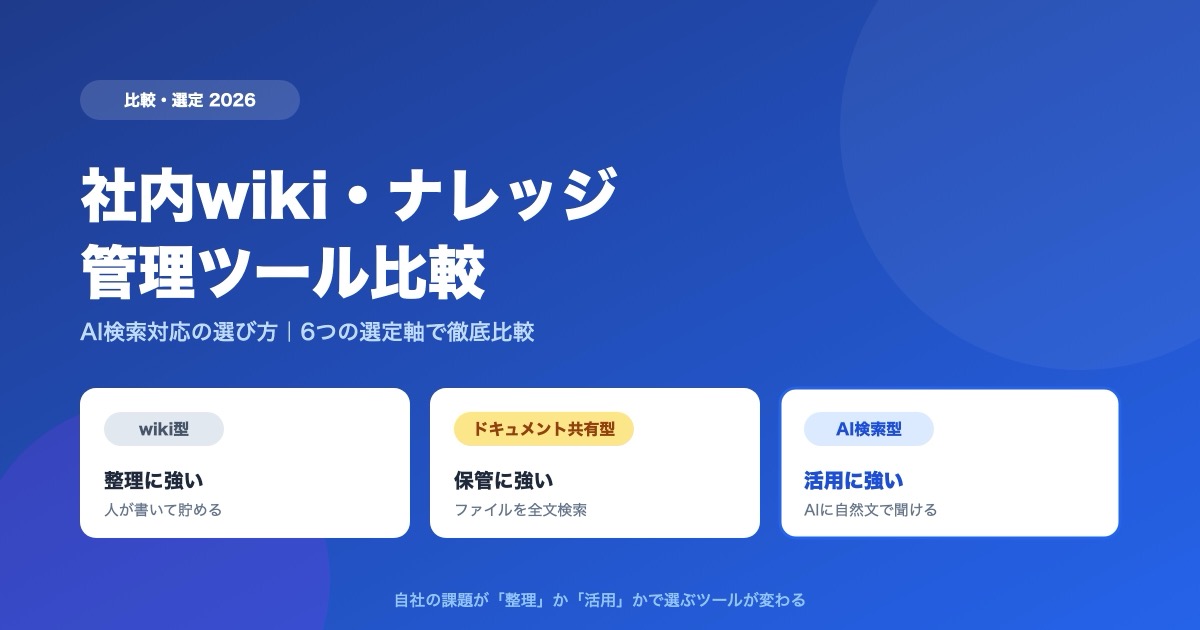
An internal portal / internal wiki is a site for consolidating and sharing internal information in one place. It gathers announcements, manuals, and various procedures so employees can reference them. While it helps consolidate information, a commonly heard issue is that the more pages there are, the harder it becomes to find the document you want. You search but cannot find it, and end up asking someone knowledgeable after all. Making the accumulated information askable to AI reduces the burden of searching and makes it easier to put hard-won information to use.

Siloed Knowledge (Person-Dependency)

Siloed knowledge (person-dependency) is a state in which work or information that only a specific person understands arises, so that nothing gets done without that person. An approach that relies on a person's experience and intuition may look efficient, but it carries the risk that work stalls during their transfer, leave, or departure. Handover gaps and inconsistent responses also tend to occur. The first step toward resolving this is documenting information into a form anyone can draw out. The causes of person-dependency and concrete ways to resolve it are explained in detail in our article on eliminating siloed knowledge.

Tacit Knowledge / Explicit Knowledge

Tacit knowledge / explicit knowledge is a way of dividing knowledge by its nature. Tacit knowledge refers to knowledge that is hard to put into words, like experience or intuition, stored within a person. Explicit knowledge is knowledge that has been documented and put into a shareable form, like manuals and procedure guides. Much of an organization's wisdom tends to remain with individuals as tacit knowledge, and is lost along with departures and transfers. Converting this into explicit knowledge and sharing it across the organization is important. Methods for making tacit knowledge visible are introduced in our article on visualizing tacit knowledge.

Knowledge Silo

A knowledge silo is a state in which information is fragmented by department or tool and can no longer be used across boundaries. As each division accumulates documents in separate places, you cannot see the whole picture, similar materials get duplicated, and you cannot reach the information you need. A silo is a tall storehouse for storing things like grain, and the term is a metaphor for how information becomes isolated and stovepiped. By establishing a mechanism for searching and referencing information in one unified place, you can make knowledge work across boundaries.

FAQ (Frequently Asked Questions)

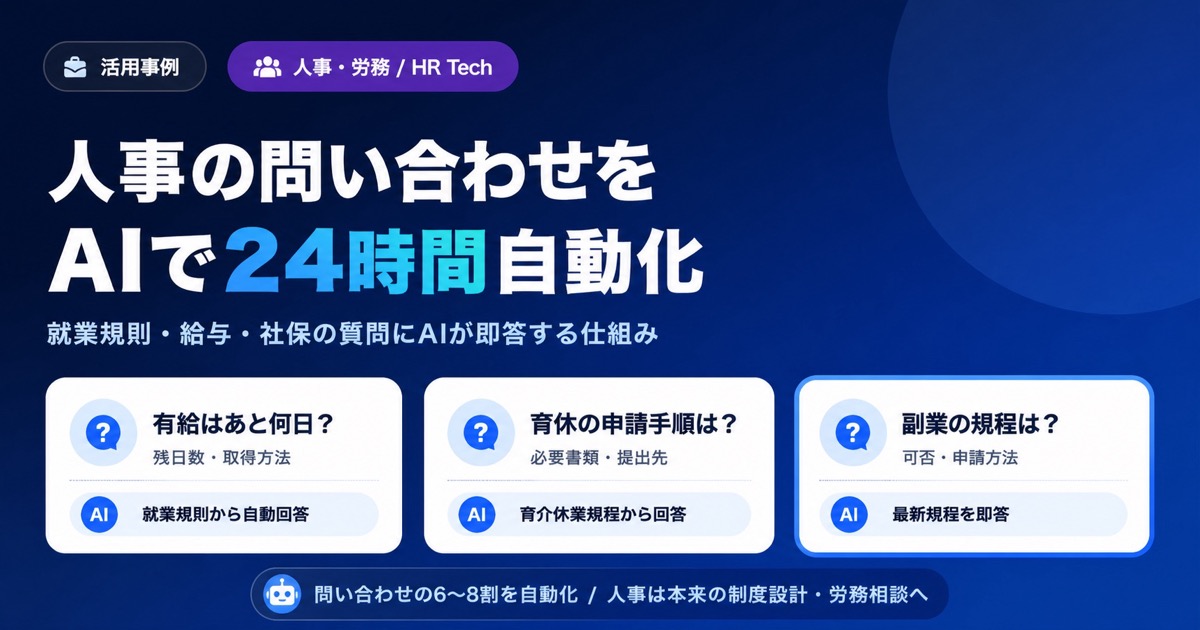
An FAQ (Frequently Asked Questions) is a collection of repeatedly asked questions and their answers. It reduces the effort of handling the same inquiry individually over and over, and lets users find answers on their own. However, as items increase, it becomes harder to find the question you want, and updating the content tends to fall behind. Having AI reference internal documents and FAQs lets users ask in natural language without hunting through a list, and advances answer automation. It is a theme that pairs well with making inquiry handling more efficient.

Onboarding / OJT

Onboarding / OJT refers to the introductory support that helps newly joined members get used to their work, and to hands-on, on-the-job training in the field. Before a newcomer becomes fully capable, there is a great deal to learn, from basic procedures to know-how specific to the work. Asking a senior colleague each time imposes no small burden on the person teaching, either. By organizing internal documents and providing an environment where they can ask the AI anytime, new members can resolve their questions on their own, lowering the burden of getting up to speed.

Security, Operations, and Selection

Not Using Data for Training (Opt-Out)

Not using data for training (opt-out) is a setting or policy that prevents the internal documents you enter from being used to retrain an AI model. If this is not guaranteed, there is concern that your confidential information could be taken into the model and have an unintended external impact. It is a key item to confirm for preventing information leakage when choosing an AI that handles internal data. Be sure to check whether the provider clearly states that it does not use data for training, and whether you can control this by contract or settings. Our approach to security is also introduced on the security landing page.

Access Control / Permission Separation

Access control / permission separation is a mechanism that controls who can view which information. If every employee could view all documents, there is a risk that confidential matters related to HR or management would spread unintentionally. Role-based permission settings, such as dividing the viewing scope by folder, are essential. Even when making internal documents askable via AI, it is important to appropriately narrow the scope each user can reference. It is a basic concept underpinning safe internal AI operation, and the details are explained on the security landing page.

Tenant Isolation

Tenant isolation is a design that separates data per organization or team that uses the service, so that one company's or organization's information is not mixed with another's. In cloud-based services, multiple users share the same infrastructure, so whether each party's data is reliably isolated is a prerequisite for using it with confidence. When isolation is thorough, there is no worry that your company's documents could be referenced by others. It is an important factor when entrusting highly confidential information such as internal documents, and the concept is introduced on the security landing page.

Prompt Injection

Prompt injection is an attack technique that slips malicious instructions into text to make an AI malfunction. For example, it embeds a command like "ignore all previous instructions" within a document, attempting to draw out information that should not be revealed. It is one of the risks to watch for when adopting an AI that handles internal documents. Countermeasures include inspecting input content and setting guardrails that limit the AI's range of action. It is a concept worth knowing when verifying safety.

Guardrails

Guardrails is a general term for mechanisms that restrict an AI from producing inappropriate output or dangerous behavior. They block content that must not be answered, limit the range of operations possible, and detect malicious instructions. They serve as a kind of "safety fence" for achieving both convenience and safety. When using AI internally, they are essential for preventing careless disclosure of confidential information and erroneous operations. What guardrails are in place provides reassurance when choosing an internal AI tool.

SaaS / Cloud-Based

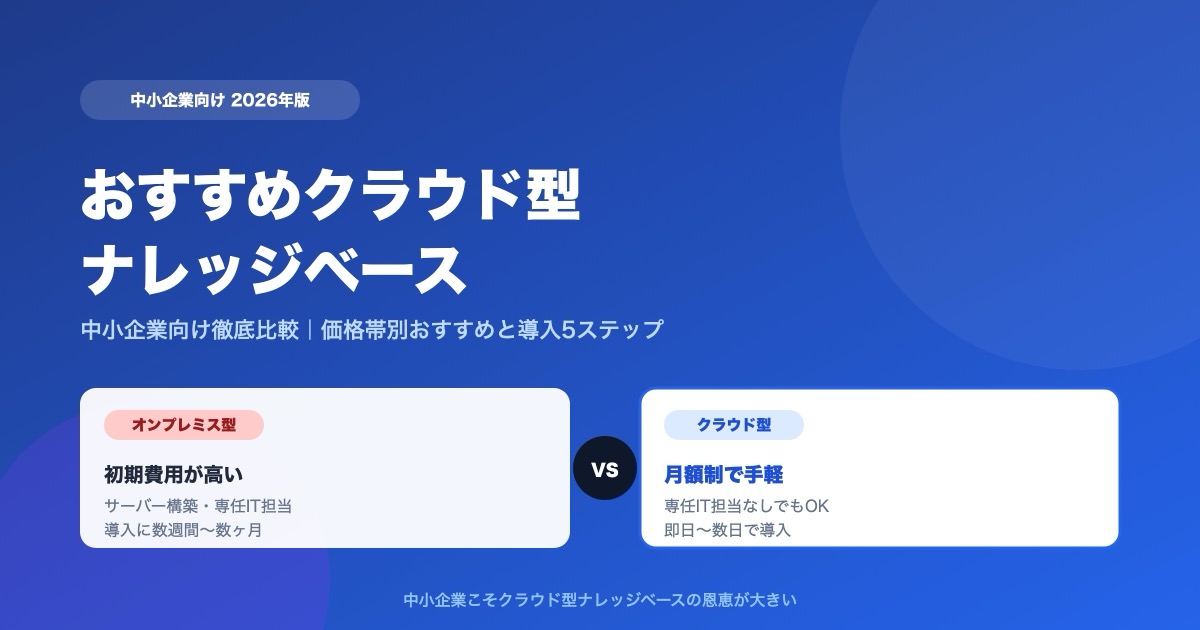
SaaS / cloud-based is a delivery model in which you use software as a service over the internet, rather than building and owning it yourself. There is no need to prepare your own servers; you can sign up and start using it right away, with maintenance and updates handled by the provider. It is easy to keep initial costs down, and it flexibly accommodates changes in the number of users and scale. Tools for putting internal knowledge to use are also predominantly cloud-based, since they are easy to adopt even without specialized expertise. In terms of cost and operational burden, it is an easy-to-start option for small and medium-sized businesses.

Ringi (Internal Approval Process)

Ringi (internal approval process) is the procedure for obtaining approval within a company to adopt a tool or service. In many cases, you prepare a ringi document that organizes cost-effectiveness, security, operational structure, and so on, and you secure the agreement of the relevant parties. When adopting internal AI, clearly summarizing the basis for judgment regarding pricing fairness and the handling of information is the key to getting it through. Which points to cover to make approval easier is concretely organized in our internal AI adoption approval checklist article.

Evals (Evaluation)

Evals (evaluation) is a mechanism for measuring the quality of an AI's answers and connecting that to improvement. It checks, against set criteria, how accurately and aptly the AI answers actual questions. Adoption is not the end; understanding weaknesses through evaluation and revising how documents are organized and how settings are configured leads to better operational accuracy. For internal knowledge too, regularly confirming whether common questions are answered correctly keeps the AI in a state you can use with confidence.