"I don't really know why we do it this way, but that's how Suzuki-san has always handled it."
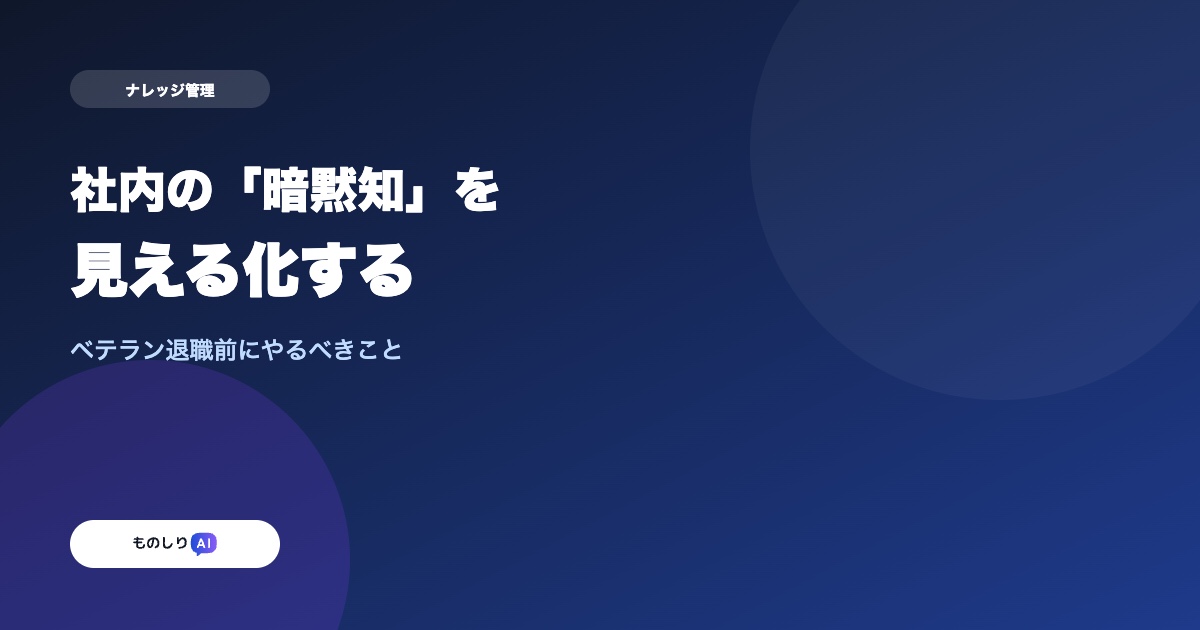
Does that sound familiar? Decision-making criteria that never made it into any manual. Know-how that can only come from years of experience. This kind of tacit knowledge is permanently lost from an organization when veteran employees leave. This article explains how to make tacit knowledge visible and preserve it as an organizational asset.
What You'll Learn
- The difference between tacit knowledge and explicit knowledge
- Concrete examples of information that exists only in veterans' heads
- Three steps to convert tacit knowledge into explicit knowledge
- A minimum action checklist to complete before departure
What Is Tacit Knowledge? -- How It Differs from Explicit Knowledge
Knowledge broadly falls into two categories: explicit knowledge and tacit knowledge.
| Explicit Knowledge | Tacit Knowledge | |
|---|---|---|
| Definition | Knowledge expressed in language or numbers | Knowledge based on experience and intuition that's hard to articulate |
| Examples | Manuals, procedures, regulations | Decision criteria, tips, intuitive judgment |
| How it's shared | Can be transmitted through documents | Tends to rely on face-to-face interaction and OJT |
| When someone leaves | Remains as documentation | Disappears with the person |
Explicit knowledge already exists as files and documents, making it relatively easy to share and store. Tacit knowledge, on the other hand, is often not even recognized as "knowledge" by the person who holds it, and won't be preserved unless it's intentionally extracted.
In the SECI model proposed by management scholar Ikujiro Nonaka, the process of converting tacit knowledge into explicit knowledge -- called "externalization" -- is considered a key driver of organizational knowledge creation.
What's Inside a Veteran's Head That Isn't Written Down Anywhere
Understanding "what our veterans actually know" is itself a challenge. Below are concrete examples of tacit knowledge commonly overlooked in organizations.
Decision-making criteria
- Unwritten rules like "this type of complaint should be escalated to a manager immediately"
- Acceptable ranges for quote adjustments and where to settle in discount negotiations
- Interpersonal know-how like "this client responds better to a phone call than an email"
Troubleshooting heuristics
- Root causes of past incidents and the actions taken to resolve them
- The order to check things in when a specific error occurs: "when you see this error, start here"
- Seasonal patterns of problems that tend to occur at certain times of year
The "why" behind current processes
- The history of how current workflows came to be in their present form
- Methods that were tried in the past and failed, along with the reasons
- Exception handling for company rules and the rationale behind those decisions
None of this is written in the "procedures" section of any manual. Yet in practice, it's often more critical to day-to-day operations than the procedures themselves. When veterans leave, the most common causes of successors repeating the same mistakes or declining customer service quality are rooted in the loss of this tacit knowledge.
Three Steps to Convert Tacit Knowledge into Explicit Knowledge
Making tacit knowledge visible doesn't have to happen all at once. The following three steps allow you to proceed incrementally.
Step 1: Extract It Through Knowledge Interviews
The most effective method is structured interviews with veteran employees. However, vague questions like "Is there anything you know that might be useful?" won't surface tacit knowledge.
Here are examples of effective questions:
- "In this process, is there anything you pay attention to that isn't in the manual?"
- "Can you tell me about a time a major issue occurred and what you did to handle it?"
- "Where do you think a successor would most likely stumble?"
- "Do you have any tips for getting this task done more quickly?"
The key is to ask questions that reference specific situations. Abstract questions yield only abstract answers. Questions like "Was there a situation last week where you had to make a judgment call?" -- grounded in recent real examples -- make it easier for the person to articulate know-how they weren't even consciously aware of.
Step 2: Record It as Documentation
Information gathered from interviews can't be used as-is. It needs to be organized into a format that others can read and understand.
The important thing here is not to aim for perfection. A simple structure like the following is more than sufficient to start:
- Situation: When does this knowledge apply?
- Decision: What judgment is made and how?
- Rationale: Why is that the right call?
- Caveats: What should be avoided? What are the exceptions?
Prioritize capturing as many pieces of tacit knowledge as possible over formatting. You can always clean up the presentation later, but you can't extract knowledge from someone who has already left.
Step 3: Store It in an AI Knowledge Base to Make It Searchable
Simply placing documented knowledge in a shared folder will eventually lead to nobody reading it. The challenge with traditional document management has always been that the more information accumulates, the harder it becomes to find what you need.
This is where an AI knowledge base proves its value. Once you upload the documented knowledge, AI understands the content at a semantic level and enables natural-language search.
For example, if you ask "What should I watch out for when handling complaints from Company A?", the AI will locate relevant information from documents created through veteran interviews and provide an answer. Tacit knowledge transforms into an organizational asset accessible to everyone simply by asking AI.
Minimum Action Checklist Before Departure
Once a veteran employee's departure has been confirmed, work through the following actions, counting backward from the departure date.
Two months before departure
- Task inventory: List every process the individual is involved in
- Tacit knowledge identification: For each process, work with the individual to pinpoint "decisions and tips that aren't documented in any manual"
One month before departure
- Conduct knowledge interviews: Following Step 1 above, hold sessions once or twice a week
- Document findings: Record interview content using the Step 2 format
- Register in the AI knowledge base: Upload created documents and verify that they're searchable
Two weeks before departure
- Successor validation: Have the successor actually use the AI knowledge base to resolve work-related questions
- Fill the gaps: Conduct additional interviews to address any gaps discovered during validation
After departure
- Ongoing updates: Keep documents current as processes evolve, maintaining an up-to-date knowledge base
The key takeaway from this checklist is that rather than waiting until departure is announced, you should have a system for continuously accumulating knowledge in place. To prepare for unexpected departures, the ideal approach is to embed tacit-to-explicit knowledge conversion into your everyday workflows.
Making Tacit Knowledge Visible Is "Organizational Insurance"
Making tacit knowledge visible benefits more than just retirement planning -- it elevates the entire organization.
- Faster onboarding: New hires can learn independently by asking AI instead of relying solely on OJT
- Consistent quality: Shared decision criteria reduce variability in how different people handle the same situations
- Less burden on veterans: Freedom from the stress of "being asked the same thing over and over"
- Organizational learning accelerates: Accumulated records of failures and successes help avoid repeating the same mistakes
Converting tacit knowledge into explicit knowledge may seem like a labor-intensive task. However, with an AI knowledge base, simply uploading documents turns them into permanent "organizational memory." Before your veterans' knowledge is lost, start with one person and one process.
Share this article
Related Articles
Solving the 'Nobody Reads the Manual' Problem with AI
Discover the three reasons why internal manuals go unread and learn how an AI knowledge base can transform documentation from something employees read to something they ask.

End the 'You'll Have to Ask So-and-So' Problem -- 5 Warning Signs Your Team Knowledge Is Siloed
Learn the five warning signs that critical knowledge is trapped in individuals' heads, and discover how an AI knowledge base can solve the problem.
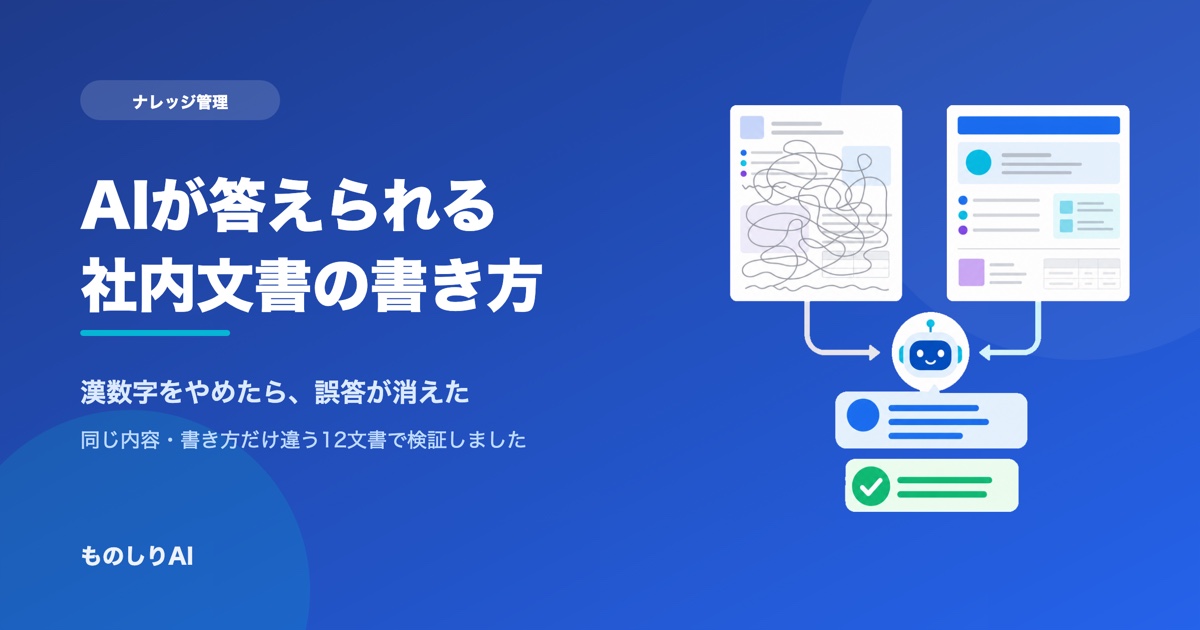
How to Write Internal Documents an AI Can Actually Answer From -- We Tested It, and Spelled-Out Numbers Were the Culprit
How should you write internal manuals and policies so an AI answers correctly? We fed 12 documents with identical facts but different writing styles into a real AI and compared the answers. What determined accuracy was not good prose -- it was number notation and the first line of the document. Here are seven rules, ordered by impact.