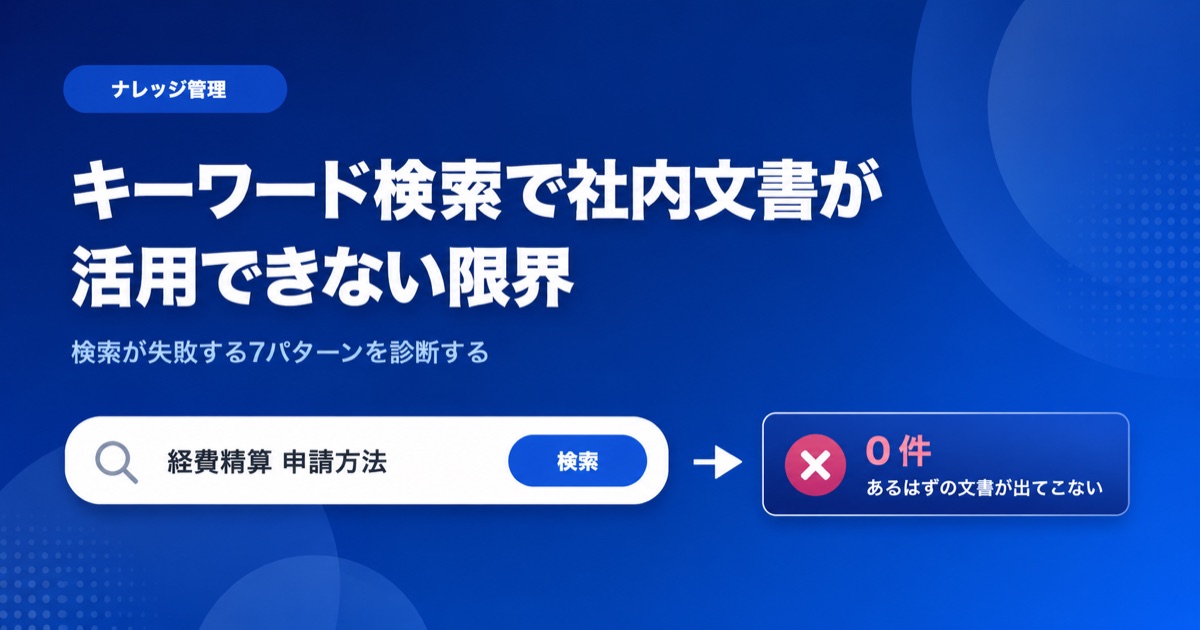

"We have comprehensive manuals." Many organizations can say this with confidence. But whether those manuals are actually used on a daily basis is an entirely different story.
According to a survey by SiteEngine Inc. (2023), over 60% of companies feel their manuals are underutilized. A separate study by CT Inc. found that roughly 90% of manual creators believe users aren't making adequate use of the documentation.
Manuals that took significant effort to create are going unread. Left unaddressed, this drives knowledge silos deeper and steadily erodes operational efficiency. In this article, we explore why manuals go unread and introduce an AI-powered solution.
What You'll Learn
- Three reasons why internal manuals go unread
- The mindset shift from "reading" to "asking"
- Practical ways to revitalize manuals using an AI knowledge base
Three Reasons Manuals Go Unread
When manuals sit unused, the problem isn't a lack of effort by their creators. In most cases, structural issues are at play.
Reason 1: People Can't Find Them
Shared drives with deeply nested folders and file names like "Manual_Latest_v3_final(2).docx" -- in this kind of environment, just locating the right manual is a challenge in itself.
According to McKinsey Global Institute research, knowledge workers spend roughly 20% of their working hours searching for internal information. For a 40-hour workweek, that's 8 hours spent just looking for things.
No matter how thorough a manual's content is, if people can't find it, it might as well not exist.
Reason 2: They're Too Long to Bother Reading
Faced with a 100-page manual, tracking down the one piece of information you need right now is daunting. Scanning the table of contents, flipping through pages, reading through related sections -- in the end, it's faster to just ask the colleague sitting next to you.
What employees on the front lines actually need isn't to read an entire manual cover to cover. It's getting the specific information they need at that exact moment.
Reason 3: The Information Is Outdated and Unreliable
"This manual was last updated two years ago -- is this procedure still accurate?"
Manuals that aren't kept current gradually lose credibility. Once the perception spreads that "those manuals are outdated," even the up-to-date sections stop being referenced. And when manual maintenance is left to individual contributors who have to fit it in alongside their regular duties, updates inevitably get deprioritized.
From "Reading" to "Asking"
What these three reasons have in common is that the act of "reading" a manual itself creates a barrier.
So let's flip the approach. What if instead of "reading" a manual, you could "ask" it a question?
Here's what that looks like in practice:
- Ask "How do I file expense reports for business trips?" and get the relevant section extracted from the expense policy
- Ask "How do I check my remaining paid leave?" and get a consolidated answer from the employment regulations and HR system manual
- Ask "What's the invoice format for Client A?" and get the template location and formatting rules
This is exactly what an AI knowledge base makes possible.
How an AI Knowledge Base Solves the Manual Problem
An AI knowledge base takes a fundamentally different approach to information retrieval compared to traditional keyword search.
Understanding the "Meaning" of Documents
An AI knowledge base reads uploaded documents and records their content as vectors (arrays of numbers) representing meaning. This allows it to find semantically related information even when the exact keywords don't match.
For example, if you ask about "remote work application procedures," the system can provide accurate answers even if the documents use terms like "work from home" or "telecommuting."
Cross-Document Answers
Instead of searching within a single manual, the AI can synthesize information across multiple documents. Employment regulations, system operation guides, department-specific rules -- scattered information gets consolidated into a single, coherent answer.
Extracting Only What You Need
Rather than handing you a 100-page manual, the system summarizes and returns only the relevant sections for your question. This fundamentally eliminates the "I don't have time to read" problem.
Implementation Is Simpler Than You'd Think
When you hear "AI knowledge base deployment," you might picture a large-scale systems project. In reality, the steps are straightforward.
| Step | What You Do | Estimated Time |
|---|---|---|
| 1. Upload | Drag and drop your existing manuals | A few minutes |
| 2. AI Processing | AI automatically reads and indexes the content | Minutes to tens of minutes |
| 3. Start Using | Simply ask questions through the chat interface | Immediately |
There's no need to rewrite your manuals from scratch. Leveraging your existing documents as-is is one of the biggest advantages. The system supports file formats you already use, including PDF, Word, Excel, and PowerPoint.
Check out the Monoshiri AI features page for details on supported file formats, chat widget capabilities, and more. For pricing information, visit the pricing page.
Start with the Most Frequently Asked Question
You don't need to AI-enable all your company's manuals at once. The recommended approach is to start with the manuals related to the questions people ask most often.
For example, if you're in general affairs, start with expense reports and leave request procedures. For IT departments, VPN connection guides and password reset instructions. Starting with high-frequency inquiry topics makes it easier to see results and smoothly expand adoption across the organization.
Summary
The root cause of unread manuals isn't the content itself -- it's the high barrier of the act of "reading".
- Can't find them -- Document locations are hard to track down
- Too long to read -- The cost of finding the right information is too high
- Outdated and unreliable -- Updates can't keep pace, eroding trust
These problems can be solved by transforming manuals from something you "read" into something you "ask." By leveraging an AI knowledge base, you can make the most of your existing documentation while fundamentally improving how your organization accesses information.
If you're dealing with the challenge of "having manuals that nobody uses," why not start small with the topic that generates the most inquiries?
Share this article
Related Articles

End the 'You'll Have to Ask So-and-So' Problem -- 5 Warning Signs Your Team Knowledge Is Siloed
Learn the five warning signs that critical knowledge is trapped in individuals' heads, and discover how an AI knowledge base can solve the problem.
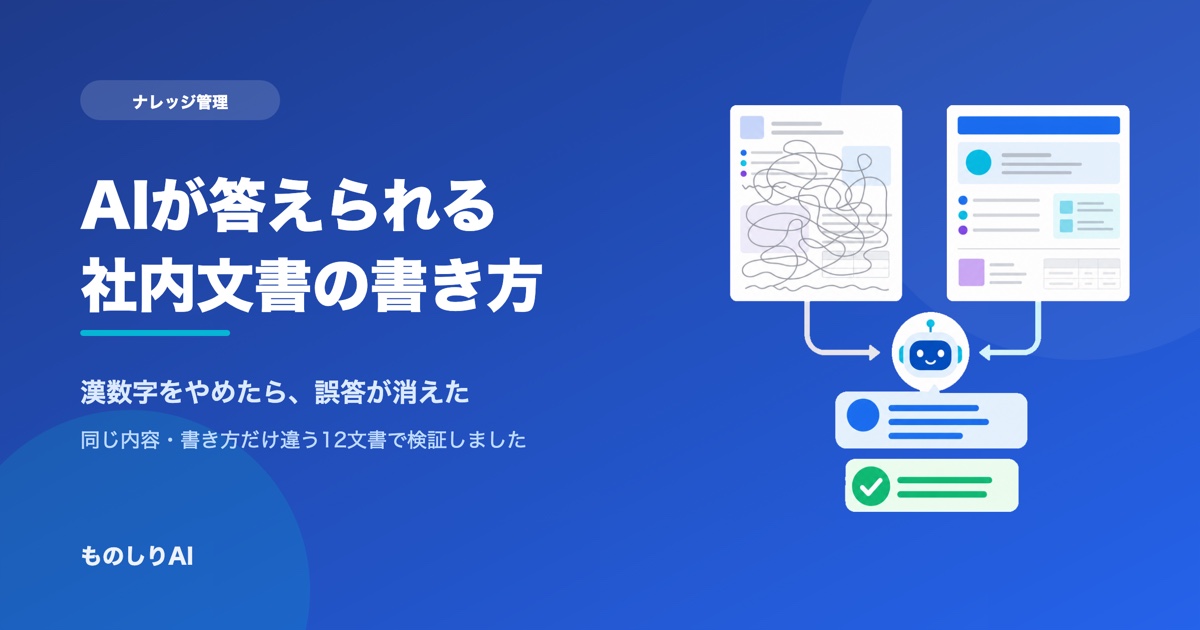
How to Write Internal Documents an AI Can Actually Answer From -- We Tested It, and Spelled-Out Numbers Were the Culprit
How should you write internal manuals and policies so an AI answers correctly? We fed 12 documents with identical facts but different writing styles into a real AI and compared the answers. What determined accuracy was not good prose -- it was number notation and the first line of the document. Here are seven rules, ordered by impact.

How to Make Tacit Knowledge Visible -- What to Do Before Your Veterans Leave
Learn how to convert the tacit knowledge that disappears when veteran employees retire into explicit, documented assets for your organization, explained in three actionable steps.