
"We already let people use ChatGPT in a few departments, but we have no rules around it. Is that really fine?"
In Japan, the AI Promotion Act took full effect in 2025, and in March 2026 the AI Guidelines for Business were revised to version 1.2. The headlines are easy to find. What your own company is supposed to do about them is much less obvious.
This article works from the published primary sources and lays out what Japanese law and the guidelines actually ask of a small or mid-sized company, through to the specific items worth writing into an internal AI usage policy.
What you will learn
- The difference between Japan's AI Promotion Act and the AI Guidelines for Business, and how binding each one is
- Why a company that merely uses ChatGPT counts as an "AI User" under the guidelines
- Why it is worth setting internal rules now, even though the AI Promotion Act itself carries no penalties
- The 10 items to include in an internal AI usage policy
- What to decide on top of that before you let AI read your internal documents
Start here: a law and a set of guidelines are not the same thing
AI topics tend to get lumped together as "regulation," but in Japan two instruments of very different character sit side by side.
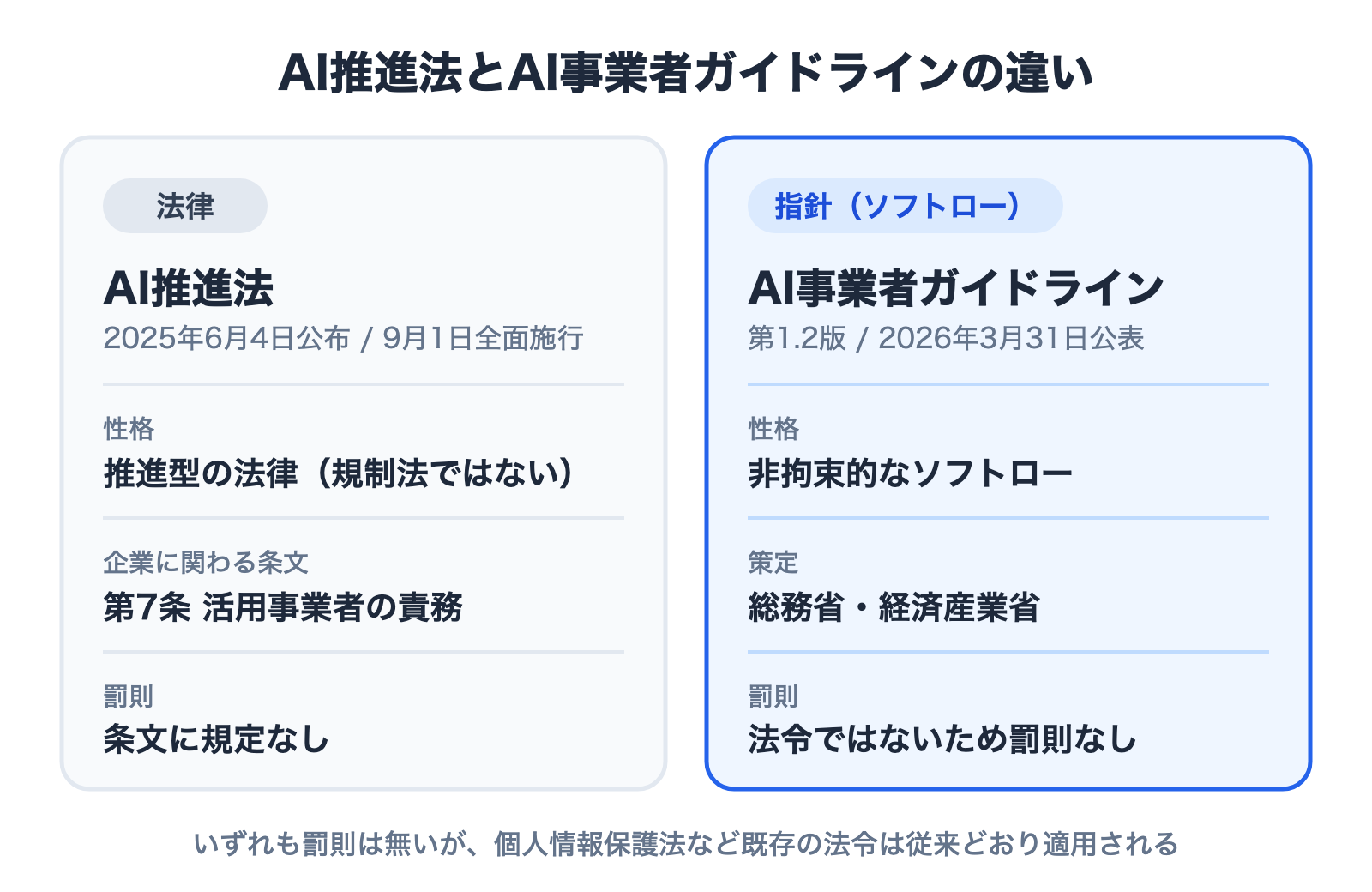
The AI Promotion Act (formally: the Act on the Promotion of Research and Development and Utilization of Artificial Intelligence-Related Technologies, 人工知能関連技術の研究開発及び活用の推進に関する法律)
Promulgated on June 4, 2025 and fully in force from September 1 of the same year. As the name says, its purpose is to promote research, development and use. It is not a regulatory statute that polices businesses.
The part that touches private companies directly is Article 7 (duties of utilization businesses). It designates anyone seeking to use AI in their business activities as a "utilization business," and provides that they shall endeavor to make active use of AI in line with the Act's basic principles, and shall cooperate with measures taken by the national and local governments.
The Act contains no provisions for criminal penalties, fines, imprisonment, or administrative fines. That said, Article 16 provides that the national government shall analyze cases in which rights and interests have been infringed, and, based on the results, provide guidance, advice, information and other necessary measures to utilization businesses and others. The design is not enforcement through penalties, but analysis of cases by the government followed by guidance, advice, and the provision of information. It is not a provision that grants powers to demand reports from a specific company or to conduct on-site inspections.
The AI Guidelines for Business, version 1.2
A document published on March 31, 2026 by Japan's Ministry of Internal Affairs and Communications (MIC) and Ministry of Economy, Trade and Industry (METI). It is the successor to version 1.0 (April 2024) and version 1.1 (March 2025).
The guidelines themselves state that rule-based regulation imposing granular conduct obligations can impede innovation, and that they were therefore written around "a goal-based approach that guides parties toward the objective through non-binding soft law." In other words, failing to follow the guidelines is not in itself immediately unlawful; they are positioned as Japan's standard reference that businesses are expected to consult voluntarily. However, some of the matters written in the guidelines — the handling of personal information, for instance — have their basis in existing law. The guidelines being non-binding, and the obligation to comply with the laws underlying them, are two separate things.
Two further characteristics: they adopt a "risk-based approach," matching the level of countermeasures to the size of the risk, and they are described as a "Living Document" that is updated as the technology moves.
If you use an external AI service, you are an "AI User"
The AI Guidelines for Business divide the actors in AI business activity into three categories.
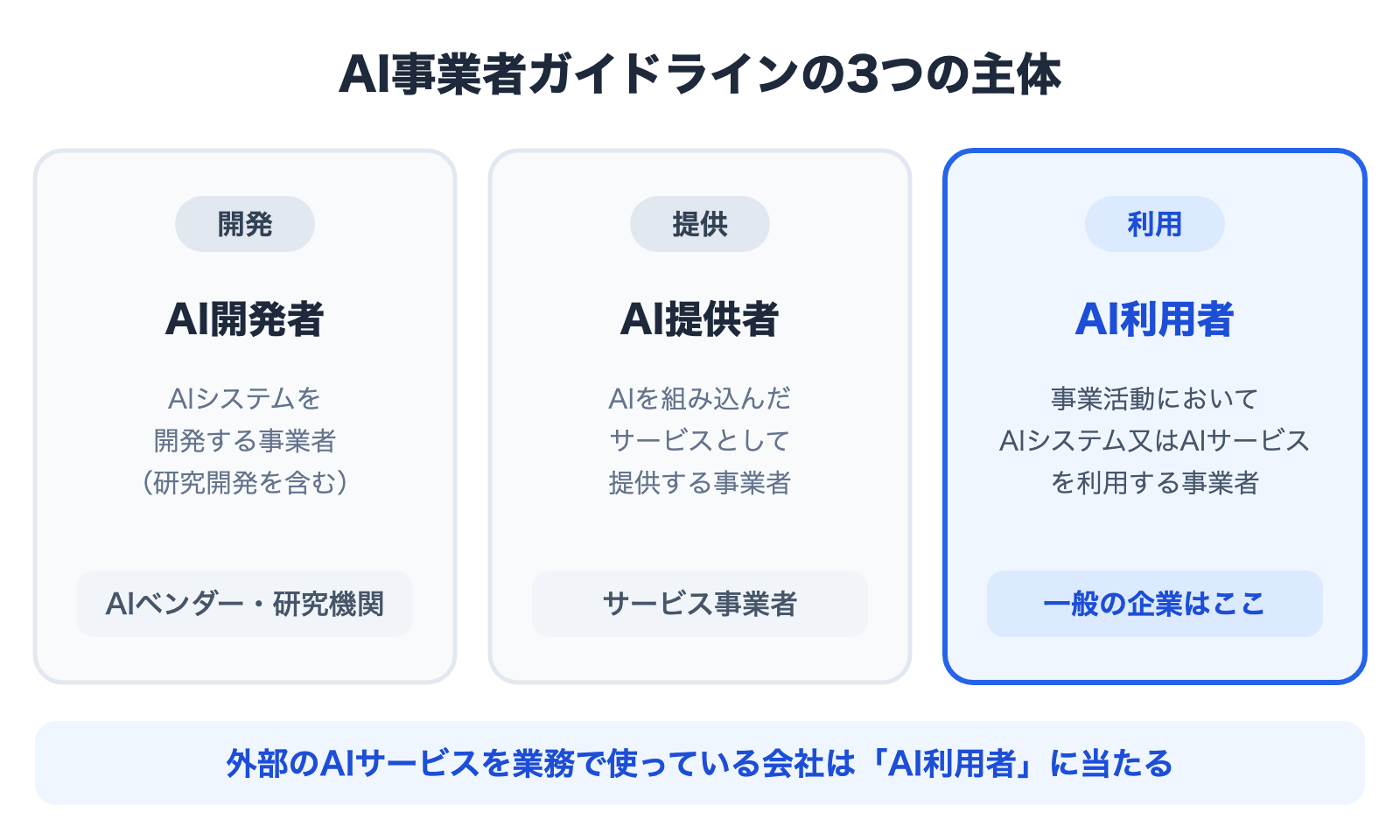
| Actor | Definition |
|---|---|
| AI Developer | A business that develops AI systems (including businesses conducting research and development on AI) |
| AI Provider | A business that provides AI systems as services embedded in applications, products, existing systems, business processes and the like |
| AI User | A business that uses AI systems or AI services in its business activities |
Note: definitions quoted from the main text of the AI Guidelines for Business (version 1.2).
The striking thing is how broad the definition of "AI User" is. Even if you develop no AI yourself, using an external service such as ChatGPT, Microsoft Copilot or Gemini for work is likely to place you within the guidelines' definition of an AI User.
Go one step further and build an internal AI chatbot for your employees or customers, and you also take on an AI Provider aspect. "We are not a software company, so this does not apply to us" is not how the guidelines are structured.
Why set internal rules now, when the AI Promotion Act carries no penalties
It is true that the AI Promotion Act itself contains no penalty provisions. What has not changed is that the way you use AI can still run into existing law. Entering personal data into generative AI raises questions under Japan's Personal Information Protection Act around the stated purpose of use, security control measures, and supervision of contractors. Pasting confidential information entrusted to you by a client into an external service can breach a non-disclosure agreement or raise issues under the Unfair Competition Prevention Act. "The AI Promotion Act itself carries no penalties" and "there is no legal risk in how you use AI" are two different statements.
Beyond legal risk, there are other reasons not to keep postponing internal rules.
Clients have started asking
In procurement by large enterprises and public bodies, vendor security questionnaires are increasingly adding questions about AI use. When you are asked "do you enter our confidential information into generative AI?" and "do you have an internal policy?", being able to name the policy and its last revision date changes how the conversation goes.
Internal approval gets easier
To an executive, adopting an internal AI tool looks like importing a data leak risk. If usage rules exist first, the approval request can be framed as "we will use it within the rules." We cover how to structure that request in a checklist for getting internal AI tools approved by IT.
You can explain yourself when something goes wrong
Someone passes an inaccurate output straight to a customer. Someone pastes confidential information into an external service. When that happens, a company with rules can treat it as an individual case that departed from the rules. A company without rules is judged to have had no management in place at all. The difference shows up not in normal times but in a crisis.
What the guidelines ask of "AI Users"
Part 5 of version 1.2 sets out the matters that matter most to AI Users. In summary:
- Appropriate use with safety in mind — observe the points of caution the provider has set out, and use the system within the scope the provider designed for. Check that it is behaving as expected. Use it with an understanding of the accuracy of its outputs and the level of risk involved
- Attention to bias in input data and prompts — input data whose fairness has been secured, and take responsibility for decisions to apply outputs to your business
- Measures against inappropriate input of personal information and privacy infringement — take care not to input personal information inappropriately, and gather information on privacy infringement as appropriate to consider how to prevent it
- Implementation of security measures — observe the security precautions indicated by the provider, and take care not to input confidential information inappropriately
- Providing information and explanation to relevant stakeholders — where outputs are used in business decisions, provide information within a reasonable scope. Where AI outputs are referred to in evaluating specific individuals or groups, give notice that AI is being used and meet your accountability obligations upon request
- Making use of the documents provided, and complying with terms of service — store and make appropriate use of the service's documentation, and comply with its terms
The level of abstraction is high, but the flip side is concrete: deciding internally what may and may not be entered, how outputs are handled, and whose terms of service you have read — and keeping a record of it — is where compliance work starts.
The 10 items to include in an internal AI usage policy
With the above in mind, here are the items worth considering for your internal rules. This is not exhaustive; adjust it up or down to fit what your business actually does. Prioritizing a policy that can be read in full on a single page, over sheer volume, is what makes it stick.
- 1. Scope — which employees are covered (does it include contractors and part-time staff?) and which AI services fall within scope
- 2. List of approved services — enumerate the services the company has contracted for or approved. State explicitly whether use of personal accounts for work is permitted
- 3. Information that must never be entered — personal information, information entrusted by customers, unpublished financial figures, source code, anything covered by an NDA with a client. Give concrete examples
- 4. Confirming whether inputs are used for training — check and record, service by service, whether the settings and contract mean input data is not used to train the model
- 5. Responsibility for verifying outputs — generated material does not go outside the company as-is. Decide who checks it
- 6. Rights and disclosure around generated material — internal standards for including AI-generated content in customer deliverables, and the situations where disclosure is required
- 7. When to tell the other party that AI was used — how to give notice and explanation where AI outputs are referred to in evaluating a specific individual, such as in hiring or performance reviews
- 8. Log retention — who asked what and when, retained for how long, and visible to whom
- 9. Escalation path for incidents — when an employee notices a mistaken input or the use of a faulty output, who do they report it to, and within how many minutes
- 10. Review cycle and owner — set a cycle such as every six months, and name the responsible department and approver
You do not need to build all of this at once. Documenting items 3 and 8 alone will already let you answer a good deal of what comes in from outside.
What to decide additionally before AI reads your internal documents
Once you move from simply asking questions of generative AI to having AI read your internal documents and answer from them, one more issue appears: where exactly are you sending the documents that are the company's own assets?
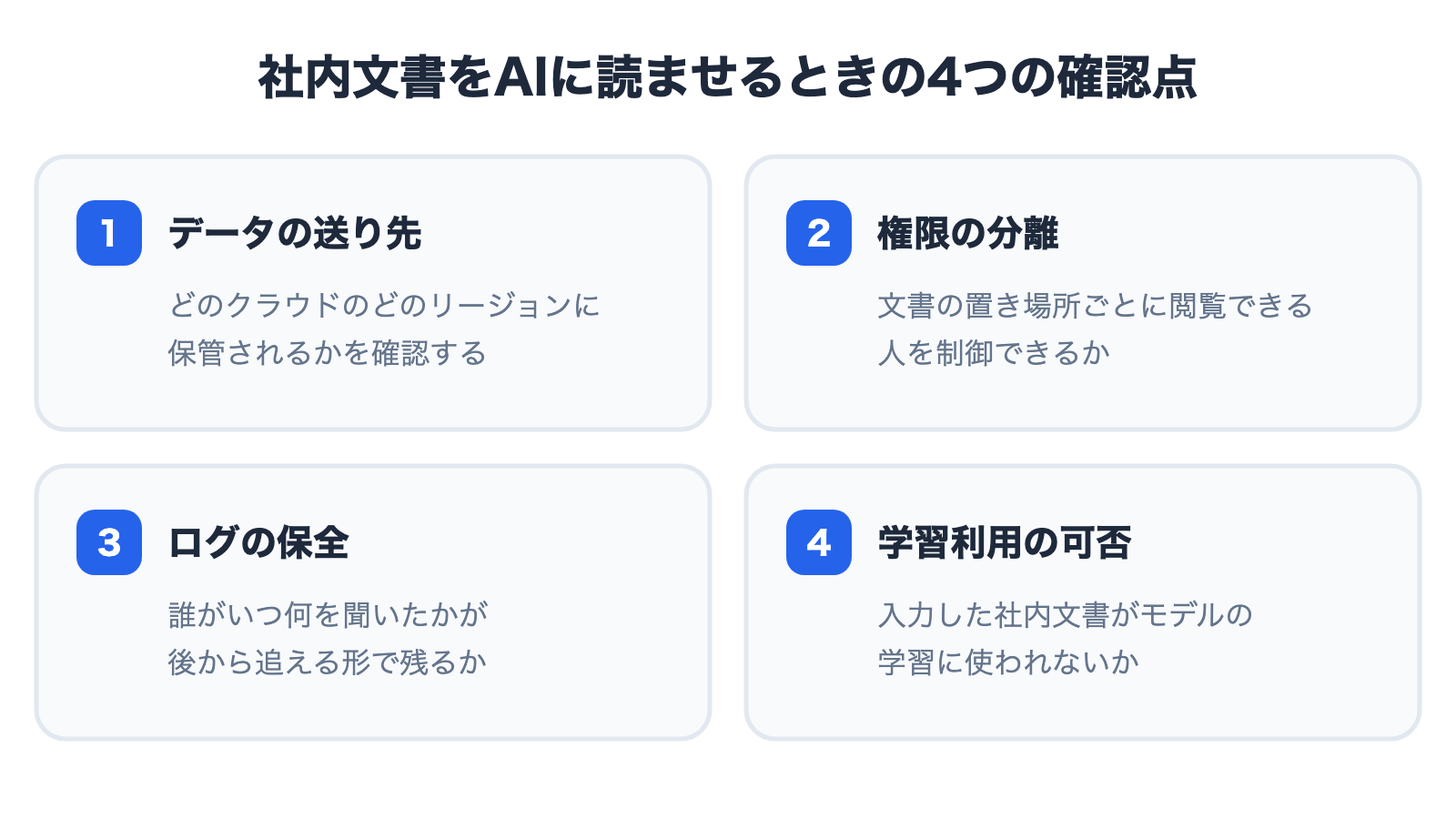
Which data goes where
Check which cloud and which region the service you use stores uploaded documents in. Where that is an overseas region, clients may ask you to explain the cross-border transfer of data.
Are permissions separated
Some documents — performance reviews, HR and labor files, board materials — are not meant for every employee. If letting AI read them means everyone can suddenly query them, your existing access controls are effectively void. Check whether you can control who can view what, per document location. We also touch on handling HR documents in how to reduce HR and labor inquiries with AI.
Are logs kept
This is the same issue as item 8 on the checklist. If the system keeps no record of what was asked, you cannot determine the scope of an incident after the fact.
Is it used to train AI
Check that the contract or the specification states explicitly that the internal documents you input are not used to train the model.
(Reference) How our own service handles this
In monoshiri AI, the service we provide, data is stored in data centers in Japan and encrypted both at rest and in transit. Data is separated by organization, and the design does not allow one organization to access another organization's data. You can also control who can view what at the folder level (on every plan). Neither we nor the foundation model providers we use train AI on the material you entrust to us. Details are on our security page. Pricing and features are on the plans page.
Note that these are specifications of the service. Adopting it does not, in itself, complete your response to the AI Guidelines for Business or your legal compliance. The scope of what may be entered, and the arrangements for verifying outputs, are things each company needs to define for itself.
New in version 1.2: AI agents
Version 1.2 introduced a definition of the term "AI agent." The main text of the AI Guidelines for Business (version 1.2) describes it as "an AI system that perceives its environment and acts autonomously in order to achieve a specific goal." It notes that "autonomous" here does not refer only to a highly autonomous state, and includes systems with some degree of autonomy.
Unlike AI that only answers questions, an agent operates external systems. Because processing can chain together without a human approving each step, we leave the text of the guidelines here and offer the following as general practical measures: from an internal-policy perspective, it is worth settling these two points up front.
- Narrow the permissions — keep the privileges of the account you hand to the agent to the minimum needed for its purpose
- Make the history traceable — ensure you can trace afterwards which decision led to which action, and review it periodically
Even at a company that has not yet rolled out agents in earnest, deciding which steps require a human approval is not wasted work.
How to proceed: three steps
Step 1: Write down the current state on one page (1 week)
Map who is using which AI service for what. Personal-account usage turns up more often than not, so prioritize collecting an accurate picture over assigning blame.
Step 2: Decide the prohibitions first (2 weeks)
Announce items 3 and 2 of the checklist internally ahead of everything else. Telling people quickly what must never be entered is more effective than waiting for a perfect policy.
Step 3: Document it as a formal policy (1-2 months)
Fill in the 10 items, set an owner and a review cycle, and turn it into an internal policy. Adding a chapter to your existing information security policy works just as well.
Summary
- The AI Promotion Act is promotional in character, and no penalties are attached to the duties of utilization businesses (Article 7). It does, however, contain provisions for the government to give guidance and advice
- Version 1.2 of the AI Guidelines for Business, published March 31, 2026, is non-binding soft law. Not following it is not immediately unlawful, but it is referenced as Japan's standard guidance
- Simply using an external AI service for work makes you an "AI User." Not developing AI is not a reason to be out of scope
- The AI Promotion Act itself carries no penalties, but existing law and contracts — the Personal Information Protection Act, non-disclosure agreements — apply exactly as before. On top of that, the reasons to get organized include client questionnaires, internal approvals, and accountability when something goes wrong
- Deciding just two things first — what must never be entered, and how logs are retained — already goes a long way in practice
- Once AI is reading your internal documents, check four things: storage region, permission separation, logs, and use for training
About this article This article is our editorial team's summary of published laws and guidelines. It is not legal advice, and it does not cover the whole of the relevant laws and guidelines. Its contents, including the specifications of our own service described here, are based on information as of September 5, 2026. What is required of you differs according to your business and your contractual terms, so please confirm final decisions with your own legal counsel or another qualified professional.
Primary sources referenced
- Act on the Promotion of Research and Development and Utilization of Artificial Intelligence-Related Technologies (人工知能関連技術の研究開発及び活用の推進に関する法律, Act No. 53 of 2025): e-Gov Law Search
- Information on the AI Promotion Act: Cabinet Office of Japan (内閣府)
- AI Guidelines for Business, version 1.2, main text (AI事業者ガイドライン(第1.2版)本編), March 31, 2026, MIC and METI: PDF
- AI Guidelines for Business, version 1.2, overview (AI事業者ガイドライン(第1.2版)概要): PDF
Share this article
Related Articles
How to Search Internal Documents with Generative AI -- What's Different from Full-Text Search and How to Roll It Out
Learn what generative AI document search actually is, and how it differs from full-text search, keyword search, and internal wiki search. A practical guide covering how it works, how to roll it out without failing, what to look for when choosing a tool, and how Monoshiri AI delivers it.
How to Add a Chatbot to STUDIO -- The Custom Code Method, Step by Step (2026)
How to install an AI chatbot on a site built with STUDIO, following the actual settings screen. Covers why a paid plan is required, why nothing shows up in preview, and why the Embed box is the wrong place for it.
How to Add a Chatbot to Wix -- The Custom Code Method, Step by Step (2026)
How to install an AI chatbot on a Wix site, following the actual dashboard screen. Covers why a connected domain is a prerequisite, the spec where changing domains deletes your snippet, and how it differs from the built-in chat.


![Automate Website Inquiries with AI -- A Chat Widget Implementation Guide [2026 Edition]](/blog/chat-widget-guide/header.jpg)